
The Faculty of Biological Sciences, Alex Ekwueme Federal University, Ndufu-Alike (AE-FUNAI), has reinforced its commitment to promoting quality teaching, effective learning and improved academic performance through a faculty lecture series focused on the practical application of Bloom’s Taxonomy and Constructive Alignment in higher education.
The lecture titled “Deploying the Concepts of Bloom’s Taxonomy and Constructive Alignment to Enhance Students’ Learning Experience and Academic Performance’ which held at the Faculty of Biological Sciences Auditorium brought together academics and non teaching to consider how teaching, learning and assessment could be better designed to produce graduates who are not just knowledgeable in the subject but also have the relevant skills to be able to apply the knowledge in the real world.
Delivering the lecture, Professor Afiukwa explored the relevance of Bloom’s Taxonomy as an instructional framework for defining and organizing learning objectives according to different levels of intellectual development. He explained that effective teaching should extend beyond the transmission of information to developing students’ abilities to understand, apply, analyse, evaluate and create knowledge.
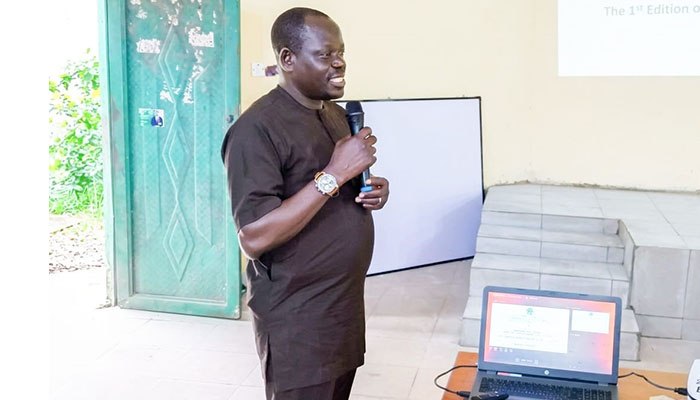
He further highlighted the importance of Constructive Alignment in ensuring that intended learning outcomes, teaching and learning activities, and assessment methods are properly connected. According to him, the effectiveness of any academic programme depends not only on what lecturers teach but also on how teaching strategies are structured to achieve clearly defined learning outcomes.
The guest lecturer emphasized that lecturers must deliberately design their instructional approaches to encourage active student participation, critical thinking, problem-solving and independent learning. He noted that aligning classroom activities and assessment with clearly articulated learning objectives would make teaching more purposeful and provide a more reliable basis for evaluating students’ academic progress.
Professor Afiukwa’s presentation underscored the need for university lecturers to continually review their teaching practices in response to evolving educational demands, stressing that the ultimate goal of teaching should be the development of graduates equipped with relevant knowledge, intellectual competence and practical skills.
Earlier, the Dean of the Faculty of Biological Sciences, Professor Chinedum O. Eleazu, welcomed participants and highlighted the importance of the lecture series as a platform for knowledge exchange, academic reflection and the improvement of teaching practices. He expressed appreciation to the Vice-Chancellor for his support and to Professor Afiukwa for accepting the invitation to share his expertise with members of the University community.

He reiterated the faculty’s commitment to maintaining the Lecture Series as a vehicle for academic engagement, for the professional development of staff and for the promotion of innovative teaching practice with the aim of enhancing the student learning experience and student performance.
In an interactive session, Prof F.C. Chilaka, complimented Prof Afiukwa’s presentation describing it as insightful, inspiring and very practical. He stressed that Bloom’s Taxonomy and Constructive Alignment should not be confined to the realm of theory but, should be made manifest in the actual teaching of the day. He pointed out that the lecture had highlighted the shortcomings of the conventional approach to teaching where the lecturer does all the talking and the student is a passive recipient.
In his view, “an educational system which is essentially about the delivery of information and the testing of recall is not going to equip our students adequately for the real world”.
Prof Chilaka set out three practical lessons for lecturers which states that the course content, the practicals and the exam questions should align with the intended learning outcomes. That students should be engaged through a variety of activities including experiments, observation, data analysis, presentations, group work and case studies. And, that feedback on assignments, practical reports and seminars should be given promptly and constructively. He opined that this would lead to students taking ownership of their own learning, building confidence and allowing errors to be corrected at early stage. He challenged the Faculty to establish a common teaching standard whereby every course outline would clearly state the learning outcomes, the learning activities and the assessment methods. He maintained that success in an academic programme should not be judged solely on the number of students who pass their exams but on their ability to apply what they have learned, to analyse problems and to come up with real solutions.
The lecture concluded with a question and answer session where attendees sought clarification on a number of issues relating to the development of measurable learning outcomes, teaching effectively in large classes and the design of inclusive learning activities to cater for students with different learning needs.
Earlier, the Dean of the Faculty of Biological Sciences, Professor Chinedum O. Eleazu, welcomed participants and highlighted the importance of the lecture series as a platform for knowledge exchange, academic reflection and the improvement of teaching practices. He expressed appreciation to the Vice-Chancellor for his support and to Professor Afiukwa for accepting the invitation to share his expertise with members of the University community.

The Faculty have reiterated their commitment to maintaining the Lecture Series as a vehicle for academic engagement, for the professional development of staff and for the promotion of innovative teaching practice with the aim of enhancing the student learning experience and student performance.
