
By Elom Iyke Ubochi
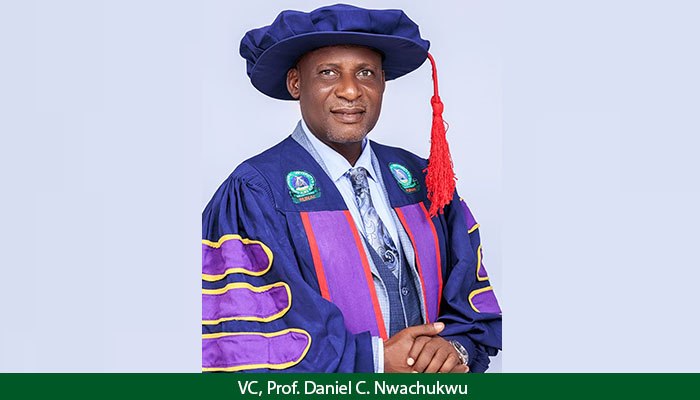
Alex Ekwueme Federal University Ndufu-Alike, Ebonyi State, is marking a new chapter in its history as its 4th substantive Vice-Chancellor, Prof. Daniel C. Nwachukwu clocks 100 days in the office. Having assumed office on February 11, 2026, the Vice-Chancellor has moved swiftly to reposition the university as a hub of academic rigor, ethical governance, and innovation-driven growth.
1. A Vision Anchored on Excellence
From day one, the Vice-Chancellor set a clear mandate: make AE-FUNAI a destination for scholarship, character, and impact. His vision is anchored on three pillars—academic excellence, administrative integrity, and student-centered leadership, all geared towards making the university an epicenter of academic and intellectual excellence.
Speaking during his inauguration, Prof. Nwachukwu emphasized that “a university must be more than a place of certificates. It must be a space where ideas are born, character is formed, and solutions for society are engineered.” That philosophy has guided every of his actions and activities in the last 100 days.
2. Driving Ethics and Decentralizing Governance
One of the earliest signals of change was a push for ethical governance and administrative accountability through the maiden AE-FUNAI Retreat 2026 with the theme, “A New AE-FUNAI Rising”. Processes are being streamlined to reduce bottlenecks, while powers have been decentralized to faculties and departments to encourage ownership and faster decision-making. Additionally, the Vice-Chancellor has also mandated the election of Faculty Deans, giving opportunity to faculty boards to select their deans in free and fair elections, and thus promoting democratic governance in the university.
A landmark move was granting the College of Medical Sciences semi-autonomous status. The decision is already easing operational coordination and creating room for the college to expand clinical training and research partnerships. He has also mandated that the position of the College Provost will be by election, not appointment as it was before he assumed office.
To track the key performance indicators (KPIs) established by the Vice-Chancellor for all faculties, a quarterly performance review was set up where deans of various faculties are expected to present a quarterly report to the university management on their achievements, challenges and way forward. With this, it will be easy to evaluate the progress made in meeting strategic academic goals of the university, and to make sure the administration remains on track.
3. Student-Centered Administration
Students have felt the impact directly. Hostels across campus are undergoing renovation, with new mattresses (650) and fans (120) distributed to improve living conditions of students. Specifically, the renovation of the females’ hostel C has been completed. For many students, these changes have made an immediate difference in their day-to-day comfort while focusing on their academic activities.

The administration is advancing the digitalization of the Bursary and Registry departments. Once fully deployed, the system will simplify students’ admission and registration processes, clearance, transcript processing, and other student-centered services, cutting delays and reducing manual bottlenecks, and thereby eliminating the incidence of alleged extortion among staff. The digitization of inter and intra university transfer process has been completed. Candidates can now access and fill application forms online on the university website.
The Vice-Chancellor through one of his strategic contacts with the member representing the OHANIVO Federal Constituency in the National Assembly, Hon. Nkemkanma Kama, attracted a 10-year scholarship award for 20 indigent students of the university by OPAY Digital Services worth N60M. This is unprecedented in the annals of the institution.
4. Academic Growth and Accreditation Milestones
Academic quality has been a major focus. Under his watch, the university secured the full accreditation of 10 of its academic programmes from the National Universities Commission; thereby strengthening AE-FUNAI’s standing with regulatory bodies and boosting confidence among prospective students, parents, partners and other stakeholders. Some of the fully accredited programmes include: Business Administration, Criminology & Security Studies, Public Administration, among others. It is instructive to note that the programmes were presented for accreditation by the immediate past administration of the university before their exit.

In a forward-looking step, the university has launched the Institute for Future Skills and Innovation, with a flagship focus on Artificial Intelligence. The institute is designed to equip students and staff with practical, industry-relevant skills in AI, data science, and emerging technologies, positioning AE-FUNAI to contribute meaningfully to Nigeria’s digital economy.
5. Establishment of New Academic Programmes
To keep the university dynamic, competitive, and responsive to the changing demands of the 21st century knowledge-based economy, Prof. Nwachukwu within the first 100 days of his leadership got the university senate approval for the establishment of new strategic academic programmes in the various faculties of the institution. This was aimed at expanding knowledge frontiers and responding to evolving societal needs, and to equip students with relevant skills and expertise that align with industry demands, technological advancements, and national developmental goals.

By introducing innovative programmes, the university is poised to attract a broader pool of students, strengthening its academic reputation, and enhancing research opportunities, and thereby making our graduates more employable, deepening faculty engagements and enhancing partnership with industry and government.
The newly created academic programmes and their housing faculties include:
a. Faculty of Arts: Hotel Management and Tourism.
b. Faculty of Biological Sciences: Zoology, Environmental Biology, and Plant Science and Biotechnology.
c. Faculty of Environmental Sciences: Urban and Regional Planning, Estate Management, Surveying and Geoinformatics, and Quantity Surveying.
d. Faculty of Health and Allied Sciences: Medical Radiography, Physiotherapy and Optometry.
e. Faculty of Management Sciences: Marketing.
f. Faculty of Social Sciences: Social Work, and Library and Information Science.
6. Rebranding of Faculties & Departments
To realign identity, structure and academic focus to reflect contemporary educational and societal demands, Prof, Nwachukwu embarked on a deliberate rebranding of some faculties and departments for greater relevance, clarity and competitiveness in a rapidly changing world. By adopting new names, mandates or curricula, faculties and departments can signal innovation, attract special funding, and appeal to prospective students seeking admissions into the university.

Ultimately, rebranding will enhance the university visibility, fosters interdisciplinary collaboration, and eliminates outdated/ambiguous identities that may hinder growth, and thereby strengthens the faculties and departments, improves stakeholders confidence, and ensures that academic units align with global best practices. Some of the rebranded academic units include:
a. The School of Postgraduate Studies was changed to College of Postgraduate Studies with the appointment of Prof. Nwabueze Elom as Acting Provost.
b. The Faculty of Humanities was changed to Faculty of Arts.
C. The Department of Fine & Applied Arts was relocated to the Faculty of Arts.
d. The Department of Physical and Healthy Education changed to the Department of Human Kinetics and Health Education.
e. Demerging of the Department of Statistics/Mathematics into separate department.
Additionally, the Vice-Chancellor has mandated all departments to rebrand their names and contents to improve visibility and make it more appealing to prospective students and enhance employability.
7. Promoting Staff Welfare
Prioritizing staff welfare fosters a sense of value and belonging, which directly boosts morale and organizational commitment. When staff feel supported through fair compensation, training opportunities, among others, they are more motivated to perform at their best. Ultimately, sustained investment in staff welfare reduces absenteeism, ‘presenteeism’, and drives higher productivity across the board.
Based on this, the Vice-Chancellor has prioritized staff welfare, ensuring that no staff is short-changed, undermined or victimized. He appointed a new TETFund Desk Officer for Academic Staff Training & Development and Conferences and also reconstituted the TETFund Committee to enhance openness, transparency and fairness in the selection of staff. He further approved and directed the immediate upgrade of all qualified junior staff that were omitted in the last upgrade exercise organized by the immediate past administration of the university. This has elicited commendations from the Executive Council of the local branch of NASU.

8. Building Partnerships for Infrastructure and Research
Recognizing that government funding alone cannot meet the university’s infrastructure needs, Prof. Nwachukwu has opened doors to strategic partnerships with the organized private sector and good-spirited and philanthropic individuals to invest and support the university’s drive for infrastructural development.
Collaborations with INNOSON Motors and Zobis Wires and Cables are in motion, creating opportunities for research, internships, and technology transfer. A private investor/developer, AG-Zara has also been brought in to develop new students’ hostel facilities, expanding on-campus accommodation without placing additional strain on the university’s budget.

Another key project is the proposed partnership for an Integrated Water Processing Plant in the university, aimed at ensuring sustainable supply of portable water for the university community and beyond while serving as a training ground for engineering and environmental science students, and more importantly increasing the internally-generated revenue base of the university.
Through the strategic engagement of the Vice-Chancellor, the Deputy Whip of the Nigerian Senate and Senator representing Ebonyi North in the National Assembly, Onyekachi Nwebonyi pledged to erect a Faculty of Law auditorium in the university worth about N200M. When completed, the project will be a landmark edifice in the heart of the university, thus cementing the reputation of the law programme as one of the flagship academic programmes in the university.
The university acquired a property under lease agreement to be used as the university guest house. The property which is located at Abakaliki is being renovated, and will mitigate the huge financial resources expended on hotel accommodation for university guests especially during accreditations, council meetings, among others. This is a stop-gap intervention until the university completes its guest house.
9. Affiliate Institutions Engagements
To expand the university’s reach, Prof. Nwachukwu’s administration is increasing access to the degree programmes of the institution for students through the establishment of more partner colleges authorized to run its academic programmes. For our university, affiliates enhance visibility,
grow enrollment, and generate additional revenue while maintaining academic standard and integrity through shared curricula and accreditation. Consequently, within the 100 days of this administration, the university entered into affiliate agreement with Marist Polytechnic, Enugu and AE-FUTHA College of Nursing Sciences, Abakaliki. These strategic collaborations will strengthen AE-FUNAI’s regional impact and reinforce its reputation as a hub of academic and intellectual development.
10. Creation of New Centers
To drive a specialized and specific agenda outside the traditional academic departments of the university, and to improve its internally-generated revenue, the Vice-Chancellor secured the approval of the Senate for the creation of some new centers. They include:
a. AE-FUNAI Business School, to be located at Abakaliki with Prof. Abel Ezeoha as Director.
b. Centre for Distance Learning with study centres at Abuja, Lagos, Enugu, Onitsha, Aba, among others, with Prof. Philip Omoke as Director.
c. Centre for Advancement and Strategic Contacts with Dr. Nkiru Obande-Ogbuinya as Acting Director.
11. Improving Physical Infrastructure on Campus
Immediately on the assumption of Office, Prof. Nwachukwu embarked on a campus tour to have a real feel of the state of physical infrastructure on campus. Having had an on-the-spot assessment of the state of things, he knew that he had his work well cut out. He therefore pledged to ensure a massive new infrastructural development on campus and the renewal of dilapidated ones, as well as to ensure that the ongoing projects that were bequeathed to him by the immediate past Vice-Chancellor were completed on schedule. He got in touch and put pressure on the contractors to deliver the projects on schedule. Today, most of these projects like the Faculty of Social Sciences buildings and Department of Architecture buildings are at advanced stages of completion.

Prof. Nwachukwu has embarked on the lightening of the university campus through the mounting of about 150 solar street lights spanning from the university main gate to the senate building down to the College of Medical Sciences and Faculty of Law axis. This intervention which was through the support of Hon. Nkemkanma Kama has provided security cover for both staff and students at night.

Through the approval of the Vice-Chancellor, the University Medical Centre is now being powered by an independent solar light, ensuring uninterrupted power supply needed for efficient health service delivery. The era of epileptic power supply at the centre is over. This was achieved through funding from the Tertiary Institution Social Health Insurance Programme (TISHIP).

Prof. Nwachukwu embarked on a massive renovation of the Vice-Chancellor’s office and VC’s waiting room to make it 21st century-compliant and befitting of the office. It now wears a new astounding look. He also ensured the construction of 3 conveniences at the VC’s conference room. Staff and visitors alike do not need to go outside the room during the event in search of places to ease themselves.
Within this period, the Vice-Chancellor has supervised sweeping improvement in the physical infrastructure on campus. Suffice to say that approval for the rehabilitation of the Faculties of Biological Sciences and Faculty of Physical Sciences auditoriums have been secured to ensure a conducive environment for teaching and learning.

New building projects are about springing up at different places on campus. They include: The Faculty of Health and Allied Sciences building, Students’ hostel by TETFund, and another Students’ hostel to be funded by the Federal Ministry of Finance, among others.
Under his leadership, the university appointed 4 companies for the cleaning, vegetation control, sewage and solid waste disposal to ensure a clean, green, beautiful and eco-friendly campus for environmental sustainability both at the campus and teaching hospital. A university-wide environmental committee has been created to oversee and monitor the activities of the cleaning companies to ensure they discharge their duties efficiently.
12. Engaging Host Communities for Sustainable Peace and Development
Sustainable peace and development on campus has long been slowed down by land disputes involving original landowners. Prof. Nwachukwu’s administration has prioritized dialogue and engagement with critical stakeholders to resolve these issues amicably. Progress in these conversations will create a clearer path for new academic buildings, research centers, and student facilities.
As part of its Community Service the university under the leadership of Prof. Nwachukwu awarded university scholarships to three senior secondary school students from the host community. In a keenly contested essay competition organized by the Centre for Community and Extension Services among secondary school students in Ikwo, Ezaka Ferdinand Ifeanyi of Urban Secondary School Ndufu- Echara and two others were awarded scholarships for their sterling performances at the competition. This is a way of supporting and giving a sense of belonging to members of the university host communities, and thereby promoting a strong town/gown relationship.
13. Humanizing Leadership
Beyond policy and projects, what has stood out in the first 100 days of Prof. Nwachukwu’s administration is an approachable leadership style. He has maintained an open-door engagement with staff and staff unions, students, and the host community, listening as much as he communicates. That tone has helped build trust and a sense of shared ownership in the university’s future.

More poignantly, the Vice-Chancellor has approved the full payment of death benefits of some deceased staff, thereby restoring hope to deceased families that were forlorn before his assumption of office. This is a profound demonstration of his milk of human kindness and staff-centric leadership, and it will surely galvanize and motivate the staff to discharge their official responsibilities
14. Looking Ahead
At 100 days, the administration is clear that this is only the beginning. The focus now shifts to scaling up the digital systems, expanding lecture halls and hostel accommodation, enhancing the quality of academic activities, consolidating partnerships, increasing the institution’s global ranking and visibility, and ensuring that the Institute for Future Skills becomes a reality and a regional reference point for AI and technology education in Nigeria.
For a university still young in Nigeria’s higher education landscape, the message is profound: AE-FUNAI is not waiting for the future. It is building it under the leadership of Prof. Daniel C. Nwachukwu as Vice-Chancellor.b
Elom Iyke Ubochi is the Public Relations Officer of Alex Ekwueme Federal University Ndufu-Alike, Ebonyi State
